
Lock games are runaway games where the leading player can't be caught in Final Jeopardy and is guaranteed to win. This occurs when the leading player has more than twice the score of the nearest competitor after Double Jeopardy.
As an example, if Ken has \$10,000 after Double Jeopardy and the nearest player has $2,000, then Ken can wager up to \$5,999 and be guaranteed to win even if he is incorrect on Final Jeopardy. This value represents the "maximum safe wager". Do players in lock games tend to wager close to this maximum, do they play it safe and wager close to zero, or do they go somewhere in the middle? Read on to find out.
Wagers near the maximum safe wager appear at the top, while wagers close to 0 appear at the bottom.
Blue/red colors indicate correct/incorrect response. Trend lines show common wager amounts (hover to show). Click on a point to link to J! Archive page.
Contestants in lock games wager close to the maximum safe wager amount 18% of the time, and wager close to zero 12% of the time. Contestants who wagered big were more likely to be correct compared to those who wagered small (63% vs 51%).
Over-wagers are when a contestant has a lock game but wagers more than the maximum safe wager. Over-wagers by \$1 are most common (pink color) - in this case if the leading player is wrong on Final Jeopardy there is the possibility of a tie. Over-wagers by more than \$1 (red color) leave open the possibility of losing.
Squares with an "X" mean the leading player was incorrect on Final Jeopardy. Click on a square to link to the J! Archive game.
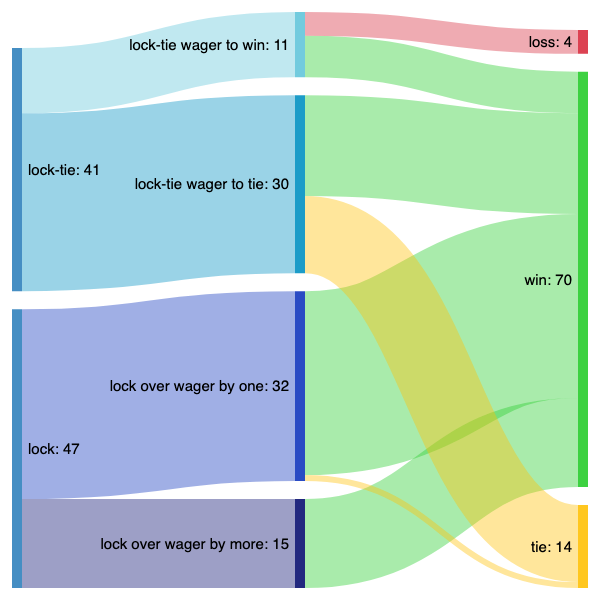
Lock-tie games occur when the leading player has exactly twice the score of the nearest competitor. If they wager \$0 it leaves open the possibility of a tie. If they wager > \$0 it leaves open the possibility of a loss. The above figure shows how often the 41 lock-tie games resulted in a win, tie, or loss for the leading player.
It also shows the outcomes of the 47 lock games where the leading player over-wagered.
Plot generated with sankeymatic
Data from the 47 lock games where the leading player over-wagered.
Data from 41 lock-tie games.
Data from J! Archive